Enterprise OS
Why Your Enterprise AI Is Failing
— It's Not the AI You're Missing. Own Your Intelligence.
Dave Tanaka / 田中訓
February 2026
This presentation reflects my personal views and does not represent the views of any employer or organization.
The Gold Rush Is Over
Don't Let the "Jeans Sellers" Win This Time.
In every gold rush, the ones who made the real fortune were those selling shovels and jeans, not the miners.
Internet, E-commerce, Marketing Automation... history repeats itself. Now, the AI "Big Wednesday" is here — a wave 30 meters high.
But if selling "AI prompts" or "training courses" has become the "essence" of AI — isn't that missing the point entirely?
The most effective and correct way to use AI lies within your daily relationships with your customers, family, colleagues, and bosses.
AI is not a magic wand. AI is not a teacher giving you the answers.
AI is a partner that takes over the drudgery, creates time, and organizes your thoughts so you can connect more deeply with the people who matter.
Your years of experience and judgment, honed in the field — that is the ultimate weapon when combined with AI.
Our goal is to use AI to reclaim our human work and life.
The Problem No One Talks About
“I once asked an internal assistant to summarize a document I had permission to access. It declined due to policy restrictions. That moment revealed something important: when AI appears "blocked," the issue is often not the model — it's the way knowledge is governed and structured.”
The AI wasn't broken. It was underfed — missing the structure of meaning, the ontology, it needed.
of organizations now use AI in at least one function
(McKinsey 2025)
Only a small share say AI is fully scaled enterprise-wide
(McKinsey 2025)
Employees still spend a significant share of their time searching for information
(MGI)
The Root Cause
It's not the AI. It's that meaning — entities and their relationships — is fragmented across systems, and no one owns the company's ontology.
Many disconnected systems • No shared map of meaning (ontology) • Fragmented search • AI can't connect meaning across them
The Idea of an Enterprise OS
An Enterprise OS lets you own your company's intelligence as an Entity Graph — and cultivate and govern it over time.
Entity Graph (the meaning you own)
Your company's intelligence — what things mean and how they connect — owned as a graph of entities and relationships. This is what finally makes enterprise AI actually work.
Cultivate & Govern (GitHub as the box)
The graph is alive. You grow and version it in a box (GitHub). commit = how meaning changes, branch = regional/department variants, pull request = reviewed changes to meaning, fork = extend to partners. The box is replaceable; the graph inside is the point.
Human Flourishing
When AI handles the routine, time comes back — not for more work, but for human work: connecting more deeply with customers, partners, colleagues, and family.
Not theory. Already built.
Inspired by Anker's product conference, I built two Entity Graphs — "the conference itself" and "the mobile-battery market." Same method, different subjects. This is what owning the meaning — who it's for, how things connect — looks like, instead of specs or meeting minutes.
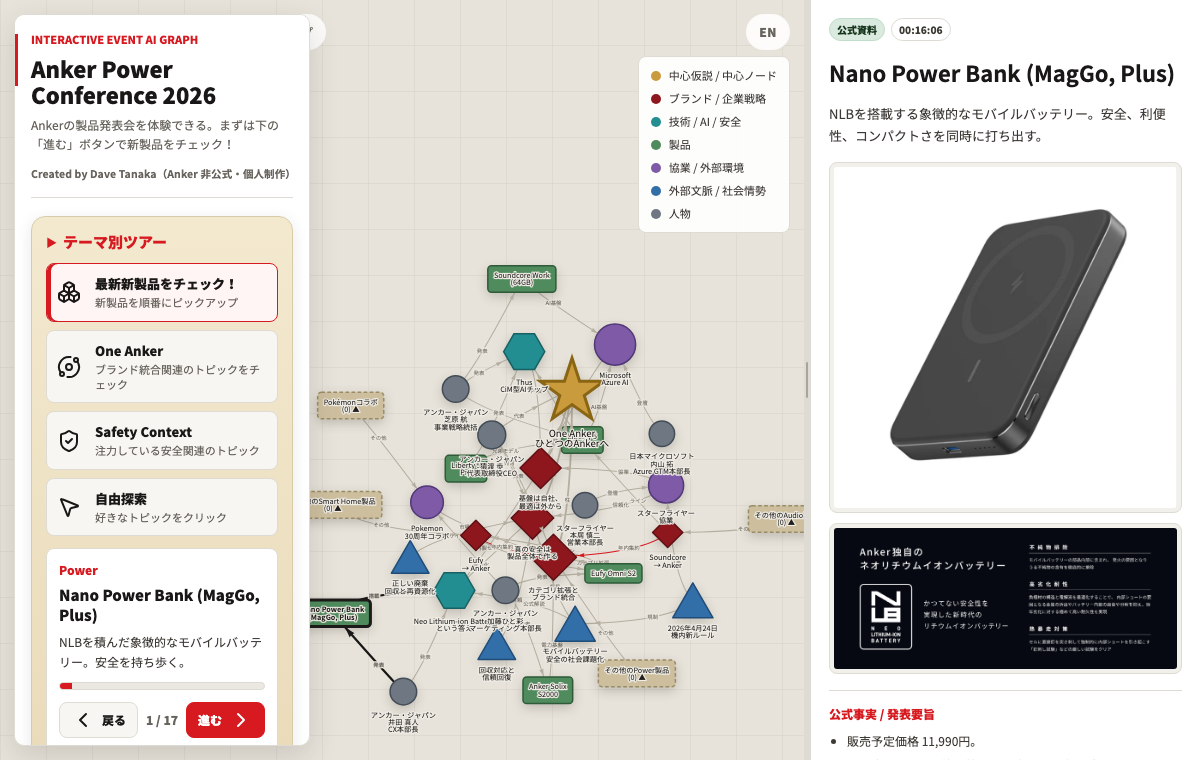 Event / People
Anker Power Conference 2026
Products, tech, speakers and booths turned into a walkable map of nodes and relationships. Owning the meaning of an event.
Explore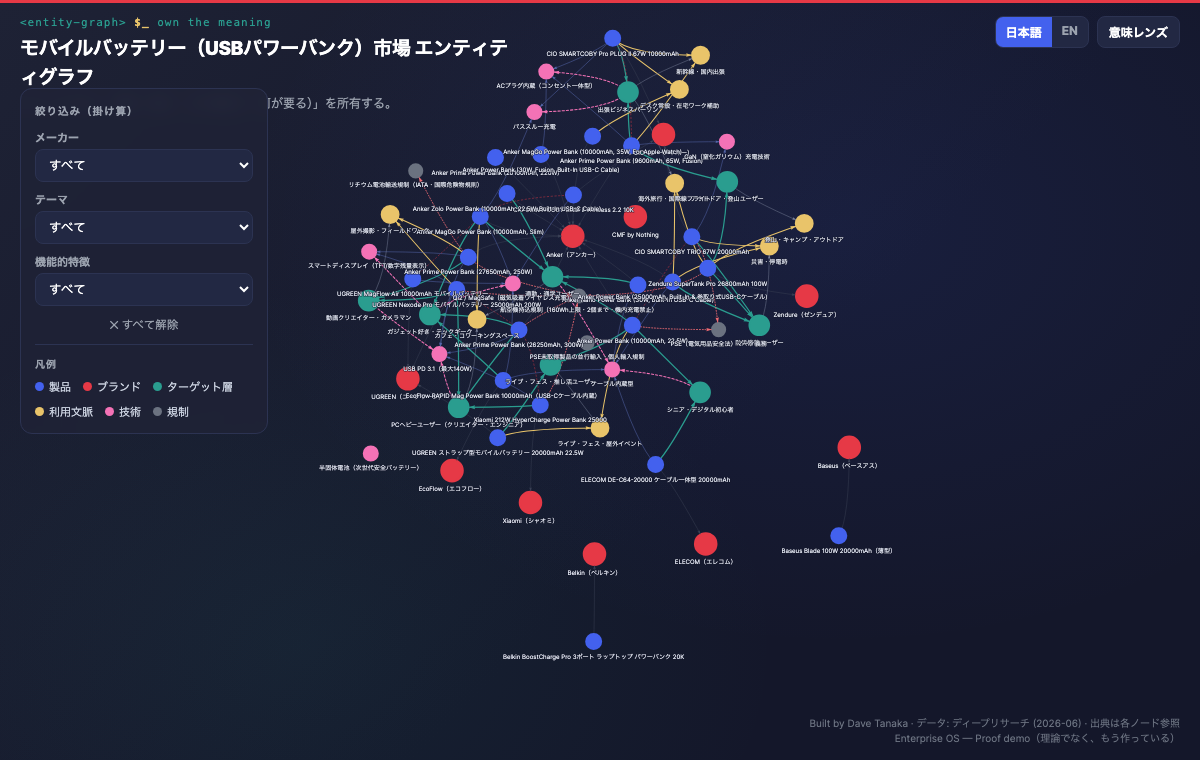 Products / Market
Mobile Battery Market Entity Graph
30 products × user segments × contexts × regulations. "Light up everything for business travelers" — one move in a graph. With a meaning lens, AND filters and guided tours.
Explore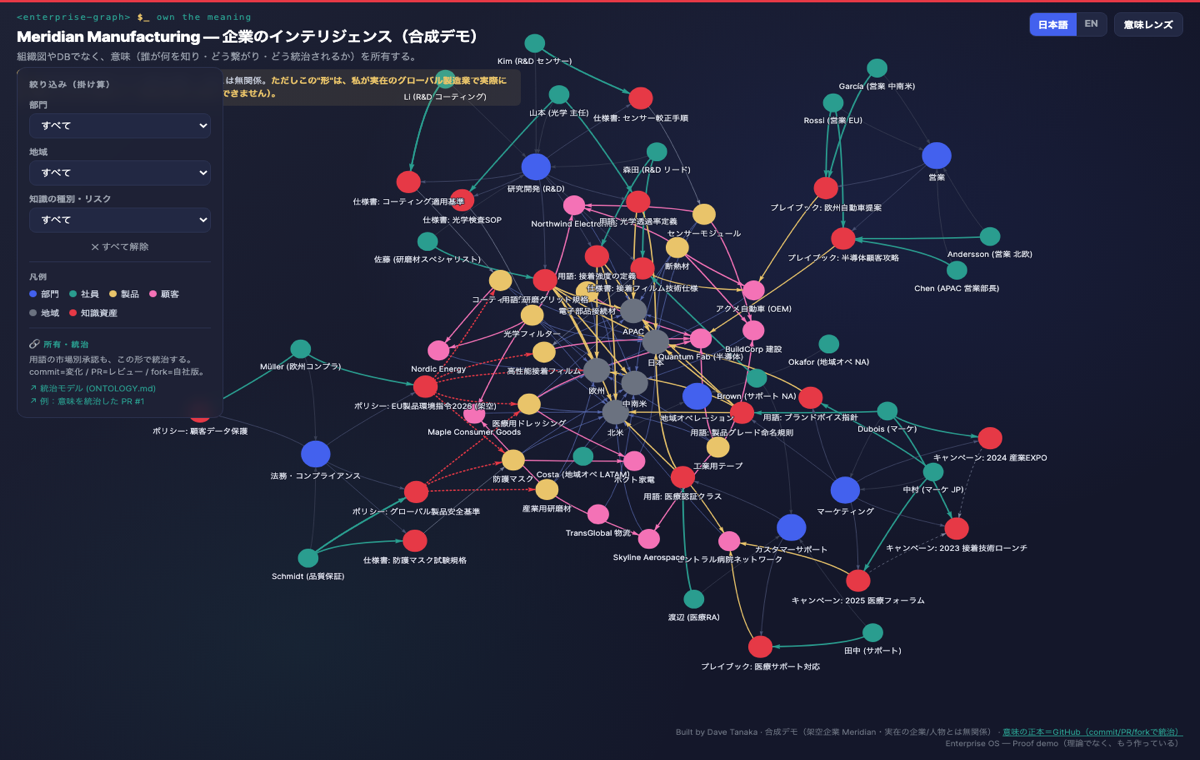 Enterprise / Synthetic
Meridian Manufacturing (synthetic)
A fictional global manufacturer: departments × people × products × customers × knowledge × governed terminology — an enterprise map of meaning. The real one is under NDA; this is a faithful synthetic.
ExploreBoth are live Entity Graphs that run entirely in the browser.
And this meaning is owned and governed: its source of truth lives on GitHub, where commits record how meaning changes and pull requests review it (AI builds the structure; humans keep it trustworthy). Rent the AI — own the meaning.
How It Works
Your owned Entity Graph at the center — GitHub is the box that cultivates and governs it, connecting data, AI, and outputs.
GitHub Enterprise
The box for your Entity Graph
Every change recorded with history and rationale
Regional or departmental variants without breaking the source
Review & approval before going live
Approved changes go live everywhere
Enables partner customization
The path — and who walks it with you
You don't have to boil the ocean. Start with one pain point: map the meaning, own it, govern it, connect AI — and know there's a role that drives it.
The implementation path
Map
Surface your entities and relationships — what things are and how they connect. Start with the one workflow where knowledge fragmentation hurts most.
Own
Put the source of truth of your meaning in a repository. Don't rent it — hold it.
Govern
Review and version every change to meaning via commit / branch / pull request. Regional and departmental variants live on branches.
Connect
Connect AI to that source of truth. It gains context, history and relationships — and becomes genuinely useful.
Scale
One team's success pulls in the next. Every connected workflow makes the platform smarter.
Who builds it — the Forward Deployed Engineer
An ontology can't be built by AI alone. It needs an embedded person who pairs domain experts with AI — drawing meaning out of the front line, structuring it, and running its governance. Palantir calls this role the Forward Deployed Engineer (FDE), a market-proven pattern. "AI builds the structure; humans keep it trustworthy" — this is that human.
I've actually done this, for a Japan-based global manufacturer.
Making It Real: Three Questions You're Probably Asking
Three questions you're probably asking — and honest answers
Your systems stay exactly as they are. Enterprise OS just connects them. GitHub Actions syncs data through REST APIs. ERP, CRM, SharePoint — mature connectors already exist for all of them. No custom middleware required. Existing review tools integrate through webhooks and PR status checks.
PoC (single workflow)
3 months
2–3 system connectors
6 months
Full enterprise rollout
12–18 months
The Cost of Standing Still
What It Costs Today
Employees spend 1.8 hours every day searching for information
(McKinsey)
of work time lost to searching for and recreating knowledge
(Bloomfire / HBR 2025)
slower cross-functional collaboration due to silos
(HBR / Bloomfire)
Lost by Fortune 500 companies from knowledge failure
(IDC)
What Enterprise OS Unlocks
Time recovered per employee with modern Knowledge Management
(Bloomfire 2025)
productivity gain from strong knowledge foundations
(McKinsey Global Institute)
GitHub Enterprise Cloud over three years
(Forrester TEI, July 2025)
less time spent searching for information
(McKinsey)
Most Fortune 500 companies already pay for GitHub Enterprise.
This isn't a new purchase. It's unlocking the value of an investment you already made. The real cost is integration and configuration — not licensing.
In Practice: Before & After
Customer Support
TODAY
- ✗Agent searches across 5 systems manually
- ✗~ 47 minutes to find relevant case
- ✗Answers vary by region
WITH ENTERPRISE OS
- ✓Agent asks the AI assistant
- ✓Finds the relevant case + similar ones in seconds
- ✓Consistent answers worldwide
Marketing Campaign
TODAY
- ✗Teams start from scratch every time
- ✗Past campaigns are hard to find
- ✗Weeks of work per region
WITH ENTERPRISE OS
- ✓AI finds 12 similar past campaigns instantly
- ✓Generates draft in hours
- ✓Automatically adapts for local markets
Why Now?
“This loop becomes the new IP of the firm.”
— Satya Nadella, CEO of Microsoft (June 2026)
Even Microsoft's CEO now argues the edge lies in the learning loop, not the model — that you should be able to swap a 'generalist' model without losing the 'company veteran' expertise built into your system.
But he draws the line at owning the loop — the process — and value there ultimately routes back to Microsoft's platform. We draw it one level deeper: what you must own is the thing the loop runs on — your meaning, your ontology.
The AI Gap Is Widening
88% of organizations use AI, but only 39% see measurable impact (McKinsey, Nov 2025). The difference isn't the AI — it's the foundation of meaning you own. Companies that own this first will pull ahead for good.
Knowledge Is Walking Out the Door
In the U.S., Baby Boomers are retiring at 10,000+ per day. Every departure without knowledge capture is permanent loss. Enterprise OS makes knowledge transfer part of daily workflows — not a side project.
The Technology Is Ready
Git, GitHub Enterprise, AI APIs — everything needed already exists. The missing piece isn't technology. It's the vision to connect what's already there.
About the Author

Dave Tanaka / 田中訓
Digital Marketing & AI Practitioner
Japan-based Global Manufacturing Company
Full slide deck available (EN/JP, 18 pages PDF)
Gadgets, AI & Digital DIY for mid-senior generations
Views are my own
30+ Years at the Intersection of Marketing & Technology
commit log
- •A rare career spanning media, creative tools, consumer tech, and global manufacturing
- •Built AI-powered enterprise tools (translation automation, technical knowledge search) — practice, not theory
- •Country Leader for AI and digital marketing adoption
- •Supported Japan deployment of global tools including Adobe Proof and ON24
- •Built and deployed internal tools via No Code / AI-assisted development
- •GitHub: 13 active repositories
- •Bilingual (JP/EN) — bridging US tech narrative and Asia-Pacific enterprise reality
- •Content creator: youtube.com/@davetanaka
Speaking & Consulting
Bringing practical AI and knowledge management insights to your organization
🏆 3M Global Marketing Excellence Award 2025
Winner for "AI Translations to Accelerate Speed to Market" — 83% reduction in campaign prep time
Speaking Topics
- ▸
Enterprise OS
Why Your Enterprise AI Is Failing — and How to Fix It
- ▸
AI Mastery: Shu-Ha-Ri
AI tools evolve rapidly, but the foundational skills employees need remain constant
- ▸
AI-Powered Knowledge Management
Turning information chaos into competitive advantage
- ▸
Vibe Coding for Non-Engineers
Building enterprise apps with AI — ¥32M+ value for under ¥9,000
- ▸
30 Years of Digital Transformation
From Web 1.0 to AI: lessons from ASCII, Adobe, Apple, and global manufacturing
Selected Speaking Engagements
- 2023
Blackmagic Design Seminar
The Frontline of In-house Video Production and Live Streaming
- 2023
SIMC Regional
The 4Cs of Revenue-Generating Digital Marketing
- 2021
Sales & Marketing DX Seminar
B2B Digital Marketing in the New Normal Era
- 2020
MarkeZine Day
How B2B Marketing And Sales Teams Can Adapt To A New Normal
- 2018
MarkeZine Day Seminar
4 Key Points to Accelerate Demand Generation
- 2017–
Internal: Digital Marketing Hacks
Quarterly sessions (now #24). 200+ attendees from Marketing, Sales, Lab & Staff divisions
Certifications & Background
Speaking & Other Inquiries
AI-driven DX initiatives, employee seminars, and how Enterprise OS concepts can benefit your organization — I'm here to help with various needs. Let's connect.
✉️Get in TouchResponse within 2 business days
Sources & References
All data cited in this presentation comes from independent third-party research
AI Adoption & Impact
- •McKinsey & Company, The State of AI (Nov 2025) — 88% adoption, 39% enterprise-level impact
- •OpenAI, Enterprise AI Report (2025) — 40–60 min/day saved per user
- •Deloitte, State of Generative AI in the Enterprise (Q1 2026) — 34% redesigning business with AI
Knowledge Management
- •McKinsey Global Institute — 1.8 hrs/day spent searching; strong KM boosts productivity 20–25%, cuts search time 35%
- •Bloomfire / Harvard Business Review (2025) — 21% searching, 14% recreating; 3.9 hrs/week saved
- •IDC — $31.5B/year lost by Fortune 500 due to poor knowledge sharing
Owning Meaning: Ontology & Knowledge Graphs
- •Google, "Introducing the Knowledge Graph: things, not strings" (2012) — the official shift from strings to entities
- •Palantir Foundry Docs, Ontology Overview — defines the ontology as the operational layer that represents the decisions in an enterprise
- •Zhamak Dehghani, Data Mesh — domain ownership of data (martinfowler.com 2019 / O'Reilly 2022)
- •Andrew Jones, Driving Data Quality with Data Contracts (Packt 2023) — data contracts that make meaning and responsibility boundaries explicit
- •MIT Sloan Management Review (2023) — AI models alone confer no sustainable advantage; the edge lies in proprietary meaning structures
- •dbt Labs / AtScale — the semantic layer: a single shared meaning for metrics across the company
- •Palantir, "A Day in the Life of a Forward Deployed Engineer" (official blog) — the embedded role that builds and governs the ontology on-site (FDE = Forward Deployed Engineer, per Palantir Foundry docs)
GitHub Enterprise
- •Forrester Research, Total Economic Impact of GitHub Enterprise Cloud (July 2025) — 376% ROI over 3 years
- •GitHub (2025) — 92% of Fortune 100; 77k+ enterprises; 180M+ users; Gartner Leader two years running
- •Enterprise customers include Mercedes-Benz, GM, Accenture, AstraZeneca, Costco, Cathay Pacific, Generali, Carlsberg
Innovation Culture
- •3M Post-it® history — publicly documented innovation story
- •3M "15% Culture" — publicly documented corporate innovation policy
Download Slide Deck
Download the full Enterprise OS concept deck (18 pages) as PDF.
This presentation is available on GitHub:
github.com/davetanaka/enterprise-osFull slide deck available: English & Japanese PDFs (18 pages each)
- • Star ★ if you find it useful
- • Fork to adapt for your organization
- • Issues and pull requests are welcome